Having Space Finding Freedom

I don’t believe in writer’s block but I do understand what it feels like to be stuck, looking for the right words when maybe any words will do. I shared over a year ago that I have been working on longer pieces that don’t lend themselves as readily to this newsletter, which was part of the reason I had not been sending as much out or with the same frequency that I used to. 

However, there is more to it than that. I started this year off with the concept of wanting more space in my life. After many years of working hard, six and sometimes seven days a week, I wanted to schedule less, reflect and rest more. But that did not happen, or at least I could not stick with that plan. In June, I wrote about learning to be present with my father as he was beginning the process of transitioning. Two days after my post, he passed on. I was with him that morning and when I got the call a few hours later, I rushed back, quickly going into the responsible mode that is familiar and second nature for me. In the hours, days, and weeks that followed, we all had a lot to take care of, and I cannot completely remember who I spoke to and when. His homegoing was a celebration of his life and I am blessed to have had such a wonderful father. I take comfort that he is at rest, and that he can be reunited with my mother—he missed her so much over these last seven years.

Where does this leave me? In some ways with more space than I have had in a long time. Some of that space is free time, and some is the hole that is there from missing my father and mother. I have wonderful memories, stories, and great family and friends, which helps a lot. And I don’t have many regrets about how I have used my time. 

These days I am trying to develop a new rhythm and routines, and resume old ones that were cast aside because of work, caregiving, fatigue, and other commitments. A last-minute train ride to Chicago with my husband. Pilates classes with different instructors. Coffees with friends who haven’t seen me as much over the last few years. Homemade soups. Reading – on my own or when I can, with an online community that talks about what is going on in our lives as much as it discusses the actual books. And rest, even though sometimes the sleep doesn’t come as quickly as I’d like. I relish my rest. 

Which brings me to my writing. Writing has always been a comfort to me, and usually comes easily. I think I worry too much about getting it right when what is most important is that I get the words down. The bigger project is going to take time, will require revision, and I will get it done, in time. But what I like about this format is its immediacy—if I have things I want to share (and write them down before I forget and get caught up in another task), getting my thoughts out in the world is not hard. I want to thank those of you who have stuck with me and I especially appreciate those who prod me when it has been too long since they have heard from me and ask about my writing. I am learning how to navigate a life that still requires structure and routine, and enjoy the space I have to create a life that works for who I am now.

A New Season

Summer might be almost over, and it is if you follow the meteorological calendar which has autumn beginning September 1. We’re past back to school season which always feels like a fresh start, at least for me. But this year is different. No longer working or employed for an organization, I am back to doing what is my first love – writing.

The word retirement – if that is what you choose to call leaving regular paid employment – doesn’t quite capture this phase of my life. I have full days, and wonder how I got so much done when I had to balance the professional, personal, and creative. I have enjoyed writing since I was at least six, and I remember the many stories I wrote and read, mainly about animals, during those first years of writing. Even while during corporate work, then nonprofit – arts, education, etc., the call back to writing never seemed to leave. So here I am, with the time and freedom to go back to the page. Last week I was part of a writing intensive, a good way to immerse myself in craft with a writing community. In between talks about writing, revising, and publishing, we also completed writing exercises, many of which will develop into complete essays.

Tending the garden (what I call yardwork), resuming my Pilates practice, having fun with family and friends, attending live performances (saw Bob James a week ago), are other ways I spend my time. And sometimes I do what appears like nothing, which is a big shift for me and something I need to almost talk myself into; I am so used to running full speed every day. But it’s all good. Like autumn, it is a good time to slow the pace, wrap up some of the old projects, and make sure everything is settled for the season I am about to enter. 

Heading Back to the Familiar

Sometimes when I have been away from what once was a regular practice, I have to ease back into it, like when you add vegetables to a food a child already likes and hope that you can sneak them in without her noticing. For me, the two practices that have been languishing are Pilates and writing. I have been so busy lately that some of the things I need to do to feel balanced have been squeezed out. For a while, that even applied to reading, because by this time last year I had already read nearly 45 books, and this year I am at about half of that number. 

I have adjusted to this new pace in life, with its restrictions on where I go and who is around me. I realize that more than ever, I need those practices that help me process what is going on in the world so I can tend to my physical and emotional wellbeing. I am back into Pilates, maybe not at the skill level I was at before, but I am practicing more frequently. And I have found that sitting for longer periods each day (aren’t we all?) means I need the movement that Pilates gives me. I worry less about how intense it is, or even how long I practice. I focus on just showing up.

And so, it is with my writing. This time last year I was immersed in my writing, heading off to a college library many mornings to write, and making progress on a book. For a while I switched to research because I had written quite a bit but wanted to go back and get more background material. The daily treks to the library slowed when cold weather came, but even at home, I wrote often. The busyness of life has crowded out my regular writing practice, or at least the part of my writing that I have not yet shared with the world. 

Sometimes it is about shifting expectations I have of myself. Just because I may not have as many hours to write doesn’t mean that 15- 30 minutes isn’t worth it. Or instead of daily writing, I can shift to longer sessions over the weekend. These days, I plan for the future, but I take it one day at a time. I remind myself that these are strange times, and while the familiar routines from my past ground me, I cannot expect that things will return to normal just by doing what once was normal and routine. I sneak in enough of the familiar so that when the unfamiliar jolts me from my path I know how to find my way back home.  

My Guest Post for Hidden Timber Books

This must be the season for guest posts for me! Last week, I wrote a post for Christi Craig, Publisher at Hidden Timber Books. My relationship with Hidden Timber Books goes back a few years, they published one of my essays and they are very supportive of writers, those they have published and many others. The essay talks about why writing is important to me and can be found here.

Recently, I have been so busy with work and other obligations that it would be easy to let my writing take a back seat to other demands. But I realized that writing is essential for my wellbeing and creativity, so even if I only have a half hour, I make time to write. I hope you are also doing something to nourish your spirit during these times.


Ramona

I Can Show You Better Than I Can Tell You — BREVITY’s Nonfiction Blog

My essay, I Can Show You Better Than I Can Tell You, appeared on the Brevity blog a few days ago and I wanted to share it with you. If you love creative nonfiction like I do, this blog, which has more than 46,000 readers, is one you should take a look at.


By Ramona M. Payne

My mother learned at an early age how to take care of herself. Her father died when she was six and life for her, her sister, and their mother was hard. I imagine that because her life was shaken by death and financial struggle, she sometimes had to go along with […]

via I Can Show You Better Than I Can Tell You — BREVITY’s Nonfiction Blog

My Favorite Books from 2019

ladywithbooks

Favorite Books from 2019

My list may not be the same as the New York Times bestseller list or another “best books of 2019” list, but here are some of my favorites reads from the past year. I read about twice as much nonfiction as fiction, but there are some great novels in this group.

Nonfiction

  • Becoming by Michelle Obama
  • Thick and Other Essays by Tressie McMillan Cottom
  • The Book of Delights by Ross Gay
  • The Color of Compromise by Jemar Tisby
  • All the Colors We Will See by Patrice Gopo
  • Educated by Tara Westover
  • The Immortal Life of Henrietta Lacks by Rebecca Skloot

Fiction

  • Elinor Oliphant is Completely Fine by Gail Honeyman
  • Pachinko by Min Jin Lee
  • The Neapolitan Quartet (My Brilliant Friend, The Story of a New Name, Those Who Leave and Those Who Stay, The Story of the Lost Child) by Elena Ferrante
  • In West Mills by De’Shawn Charles Winslow
  • Red at the Bone by Jacqueline Woodson
  • Olive, Again by Elizabeth Strout

My goal for 2020 is to keep up the pace of about one book per week, although some take longer, others, less time to read. I typically stay with one book at a time and I look forward to settling in on a Sunday and starting new book. Many readers like to use audible and e-books, but I prefer the actual book, for the experience and feel of the book, so I can make my own notes (I know e-readers let you do this), because I want to take my time with the story, trying to figure out structure and pacing and how an author keeps me turning the page. I also found that I read more since I started setting an annual goal, because I make time to read rather than waiting to have time.

How do you decide what to read—booklists, recommendations from friends and other readers, reviews, book club? I’d love to hear how readers choose their books.


Workshop News! Write.Pause.Reflect


The last two months have been busy—I launched my workshop series, Write.Pause.Reflect, in October and have been planning and delivering workshops, connecting with friends and meeting new people who are interested in reflective writing.

Write.Pause.Reflect is for anyone who is interested in using writing as a tool for managing stress, situations that cause you to worry, thoughts that keep creeping up, or issues of concern. Expressive writing, pioneered by James Pennebaker Ph.D., uses writing as a way to improve health, including mental, physical, and emotional wellbeing. In April I experienced and learned the techniques, and after my first day I knew this was a method I wanted to share with others.

What is it?

Reflective writing uses prompts and reflection on the prompts to move towards better health. In the workshops, we pause to examine the writing and our thoughts about it and consider its impact. This type of writing is different from a diary or most people’s ideas about journaling; it asks you to consider the possibility of reframing the stories we hold about our lives.

Do I have to consider myself a writer?

It is not designed solely for writers, and no, you do not have to share your work; the writing is personal.

Each workshop has been engaging and the feedback very positive. Participants are thoughtful, willing to do the writing, and respectful of each other. I continue to learn more about this process and look forward to conducting more of these workshops in 2020. Feel free to contact me if you have questions or you can comment below.

~ Ramona

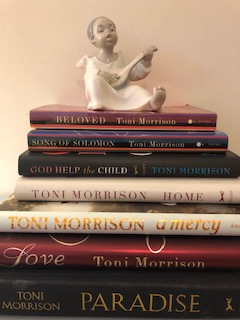
Remembering Toni Morrison (1931-2019)

Toni Morrison novels


I first read Toni Morrison in my twenties; it was the novel Tar Baby. Three decades later, I find her to be the most compelling writer in my lifetime. In her writing she chronicles and lays bare the experience of black people in this country in a way that is both affirming and gut wrenching in its truth. When I heard the news she had passed on I felt compelled to try to explain what her work has meant to me, but it is nearly impossible to do.

Maybe the best way is with a story, one related to her book Beloved. I had read Beloved before, but it was only after rereading it a couple of years ago that I truly immersed myself in the history and legacy of the story. In the book, Sethe makes the lifechanging decision to escape the cruelty of slavery in Kentucky and cross the Ohio River with one toddler child, and another on the way. When the slave catchers come after her, she attempts to kill her children rather than have them be enslaved again. It is hard to imagine making that choice as a mother, but then again, only one who had known how horrific life would be if she returned, for all of them, could understand the choice she made. Sethe kills one child before she is stopped and captured.

The story of Beloved was based, or maybe inspired is a better word, by the true story of Margaret Garner, who escaped from Kentucky, got to Cincinnati,(my hometown) and like Sethe in the novel Beloved, killed her child rather than have it taken away. Margaret Garner was captured as she killed the child, and was later tried. In another insult to her humanity, and the humanity of her children, she was not tried for murder. She was tried for destruction of property, because the child was not considered anything more than the property belonging to another human being, the slaveowner.

In Beloved, Ms. Morrison accomplished a major feat—addressing the devastating and ongoing impact of slavery on the minds, spirits, and bodies of black people, as well as the daily cruelties and suffering they endured. It is not easy to read, but I felt as if she had explained my story and the story of my ancestors in this novel. She wrote in her foreword, “In trying to make the slave experience intimate, I hoped the sense of things being both under control and out of control would be persuasive throughout; that the order and quietude of everyday life would be violently disrupted by the chaos of the needy dead; that the herculean effort to forget would be threatened by memory desperate to stay alive. To render enslavement as a personal experience, language must get out of the way.”

I read Beloved and I realized the river I grew up looking at from the bluffs of Eden Park had helped Margaret Garner pass over, and streets I knew in downtown Cincinnati had sheltered her and many others seeking freedom. Other forms of oppression awaited them, even in the north, but they sought relief from physical slavery and a chance to start new lives.

The Cincinnati Opera co-commissioned the opera Margaret Garner, and I was involved in a community engagement project to expand the audience for this opera. Margaret Garner was performed in 2005, each night sold out, and it was the most diverse audience in the history of Cincinnati Opera. There was a private reception before its opening and I was among the guests. I looked towards the door, and in walked Ms. Morrison. She was regal, her gray locks flowing, eyes scanning the room. There were so many people in the room, all eager to meet her, have their time with her. But in one moment, she saw me looking at her, and I smiled, and whispered “Hi”, trying to communicate I see you and I’m glad to see you, but I know everyone in this room wants to have your time, and I don’t want to be another person pulling at you. She smiled back, I nodded, and I left soon after. I had seen Toni Morrison, her books had already touched me, and there was no other reason for me to stay.

Ms. Morrison won the Pulitzer Prize for Beloved in 1988 and the Nobel in Literature in 1993. Our country’s greatest writer has passed on. She has been an inspiration to me because her prose was so powerful and evocative and gave attention to stories about people that had remained unknown, ignored or unexamined by many. I am grateful for the richness of her legacy and the magnificence of her writing.

***

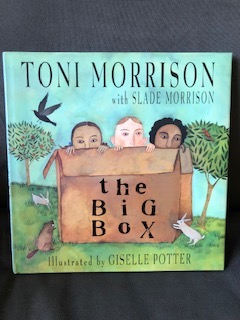
One other note: I have heard many adults say that Morrison’s work is difficult. I believe it requires careful reading, but the topics and her unflinching look at our culture are very likely what people find difficult. However, she wrote a children’s book, The Big Box, with her son Slade Morrison, which I gave out as a graduation gift for years while it was still in print. I will make sure that my granddaughters do not wait until they are 20 to pick up their first Morrison book; I am so glad to have a copy of that book in my collection.

The Big Box by Toni Morrison with Slade Morrison


August Hiatus 2019

Every year, I use August as a planning month, my equivalent of get ready for school. I want to write more, read a few books, work in my yard, and enjoy this hot weather for as long as it lasts. But before I take a hiatus from posting, here are a few things I’d like to share:

Reading  During July, I finished all four volumes of the Neapolitan Quartet by Elena Ferrante and I highly recommend these books – My Brilliant Friend, The Story of a New Name, Those Who Leave and Those Who Stay, and The Story of a Lost Child. The novels follow the relationship of two girls from Naples, Elena and Lila, from childhood to their sixties. The sometimes-complicated nature of friendship, rivalry and loyalty, the role of women in a culture that was led by men, education as a way of escaping poverty, and the backdrop of Naples, Italy and its changing political and social dynamics are key themes in these books. I read the first novel, an extremely satisfying read, and the last line made me immediately pick up the second book. If you’re still looking for a great summer read, check out these books out.

Writing  I primarily write essays and also started a novel a couple of years ago. The novel sits in a folder, and maybe one day I will revise it, or see if I want to shorten it and rewrite as a short story. Earlier this year I decided to take a break from any client work and focus on a much longer book-length project. It’s too early to give much detail, but I am enjoying the research, some travel, and of course the writing, although there are days when the words come slowly. In August I will take a few days to attend a writing conference and expect to come back home with great ideas and new energy.

Staying in touch  I’m taking a break from posting here until after Labor Day, but you can still find me on Instagram @writepausereflect or on Twitter @ramonapayne1. Enjoy your August and I’ll be back in touch after Labor Day.


Practice Makes Progress


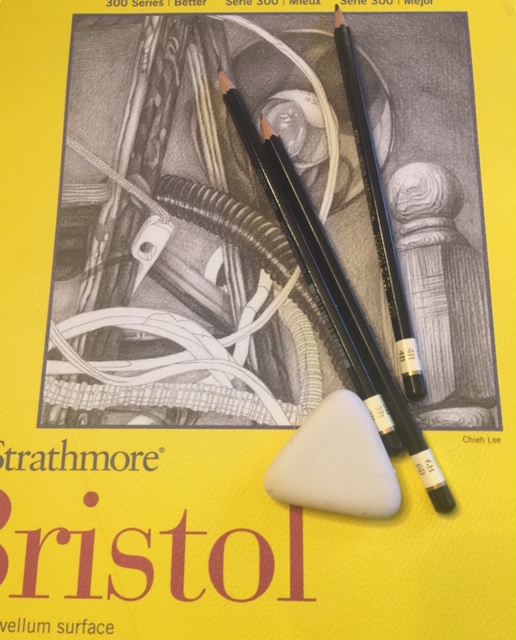
I’ve been taking a drawing class at the museum for several weeks. On the first day, our instructor asked us to draw a self-portrait. I started with the obvious—trying to capture the shape of my head, the size and slant of my eyes, the fullness of my lips, adding in cheekbones and topping the image off with hair, or enough swirls and poufs to make it look like hair.

The finished drawing looked nothing like me. Maybe there were a few aspects that resembled what I had seen in the mirror, but my drawing could have just as easily been a picture of someone else.

The takeaway for the day was to learn how to look and then sketch what I saw, rather than what I thought should be there. Next, I had to copy and draw a photo that was placed upside down, which forced me to look at lines, edges, and shapes to complete the picture. Instead of thinking, well, this is the arm, I know what an arm looks like, so I’ll draw an arm, I drew from sight, not expectation.

Guess what happened? My upside-down drawing was far more accurate than I thought it would be, because I made myself focus on what I noticed as I went along, rather than what I know.

Learning how to draw has been rewarding because the initial progress has been swift, hastened by learning some basic rules. My pictures look considerably more accurate than they would have weeks ago. There are basic principles and with practice I am learning how to employ them, observing shapes and shadows, how to measure and adjusting on the page.

I see parallels between my writing and my new drawing practice. When I write an essay, I often start out with an idea, not fully formed, just a sense of what I want to write about. As I keep going, noticing small details, or where my interest picks up, I make decisions about incorporating them into the work.

My drawing instructor recently said, “You have to bound your composition, you cannot fill everything in.” I decide which elements serve the final drawing, much as choosing the right words serves an essay or story. Drawing has taught me to look more closely at the world around me, and reinforces the truth that practice is essential to improvement. My goal is not to hang my work in a gallery or museum, although I share each week’s work as eagerly as a first-grader, excited that my hands and mind have tried to work in concert to create something. Like my writing, the process is as importance as the outcome, and the process and the practice are the two components I can control. The more I draw, the more I want to write, because they complement each other.

Writing will always come before drawing for me, but I’ll keep up with my sketches, if only because they are fun to make and use a different part of my brain. Practice does not have to make perfect, making progress is reason enough to keep on.