Winter Meditation


fullsizerender

It has been a long time since I’ve been a fan of winter. Here in northern Indiana, winter is a series of dim gray days and snowstorms, with only occasional bursts of blue skies and sunshine.

After a heavy snowfall, I wiggled into two layers of pants, a long-sleeved tee and sweater before topping it with my down jacket. I wrapped a ruffled brown scarf around my head, tied it under my chin and then topped it with a knit cap. The previous night’s snowfall covered the driveway—again—and the city’s snowplows had pushed the snow to the curb, blocking my driveway from the street, making a quick exit impossible.

Grabbing the shovel from the garage, I began the slow process of pushing snow to the side of the driveway. Push, scoop, then toss. I hoisted the shovel to throw the snow on the growing pile, which was already three feet high. Push, scoop and toss, each time making sure that I did not gather so much snow that it was too heavy to lift.

I smile when I think of my brother’s teasing, “For someone who claims to hate cold weather, it’s funny how you keep heading further north every time you move.” He’s right; every move to a warmer climate seems to be followed by a move to one that is much colder.

There have been times when winter was fun, when I could appreciate the season despite its chilly nip at my bones. I recall making angels in the snow and snowmen with my brothers. There were days when we took out the silver saucer and rode it down the hill or dragged each other around. Those are good memories. In college, before I had to drive in the snow often, the first snowfall always occurred in October. My university was not that far from Lake Michigan and when the snow travelled eastward, it picked up more and more moisture, dumping it on northern Indiana and Michigan. I did not complain; back then it was fun. With the first snow, the kids from cities down south or the west coast were the most excited. The flurries would beckon them, luring them outside. Looking through the windows at the falling snow, they tossed on their light jackets, maybe gloves and a hat, and ran outside. They tried to make snow balls, not yet understanding that they needed to wait until there was a blanket of snow, otherwise the balls would be a mix of snow, dry leaves and blades of grass. It was better if it had snowed during the night, so that by morning the landscape had shifted from green and brown to white.

That was many years ago and by the end of February, I usually have had enough of cold weather. The best parts seem to be over—the food fest that is Thanksgiving, the holiday parties, the gathering and giving of Christmas and New Year’s Eve—these events center around time with family and friends, with special food that only comes once a year. I decorate for the holidays, going a bit more rustic and golden for Thanksgiving, and then changing into reds and greens for December.

When it is this cold I feel trapped, isolated from the world. It is too cold to walk outside and sometimes the streets are too icy and slushy to make driving safe. Winter requires slowing down, and I am forced to pay attention and move without hurrying.

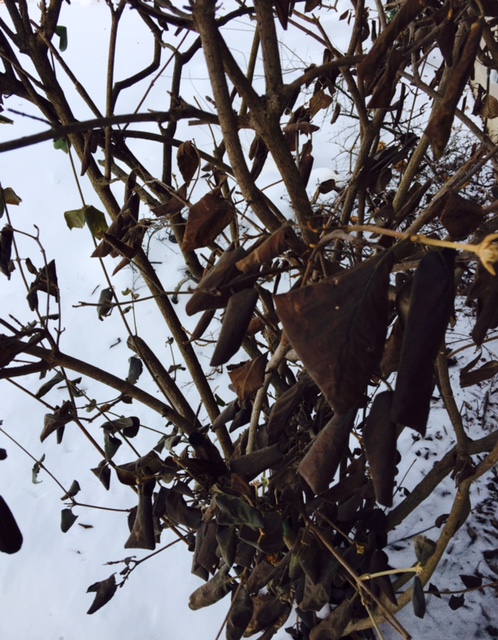
Looking outside I see my neighbors’ rooftops, the ones usually hidden by tree limbs, leaves and shrubbery during the rest of the year. I think I really should learn the names of these bushes. One is tinged red at the topmost branches, where the growth is newer from last summer. Not a dogwood, I decide. The large viburnum near the dining room window has lost nearly all of its fragrance and leaves; the ones remaining hang like brown, desiccated bats, sleeping upside down among barren branches.

I see one red roof, with a stripe of snow that has not melted. The sky is gray and cloudy, so the sun has not done its work.

I hear the chimes clanging outside. I purchased them for their pleasant sound, and when I got home I took them outside to the sunset room, the small screened-in porch that is just off of the dining room.

When it is windy in the winter I hear the chimes more often than I do when the weather is warmer; perhaps it is because there are fewer outside distractions in winter and nothing to buffer the sound. The landscape is white, sometimes so white that when it is windy that it is the only thing I see—whiteness, like a blank canvas, ready for whatever the artist chooses to place on it. The trees, except for the conifers and one resilient bush, are brown and bare. The only sounds I hear are the occasional clicks of the furnace kicking back on and the scratch of my pen against paper. Maybe that is why I hear the chimes more frequently—the world, inside and out, is still.

There go my chimes again, reminding me that there is life and movement outdoors.

I called a friend and told her I was feeling low for no apparent reason, trapped like a snow prisoner.

“What was your intention for this winter?” she asked, “ I remember talking to you about this a couple of months ago.”

Like a fierce wind, the memory rushed back.

“I said that this winter was going to be different. Instead of complaining about the cold, I’ll be grateful for the opportunity for restoration that comes with this season.”

Just as nature needs to rest and shore up energy for the promise and renewal of spring, so do I. Now I am learning how to be in flow with nature, not fighting against it.

The chiming has stopped, waiting for the next burst of wind.


Why Giving Well is Living Well


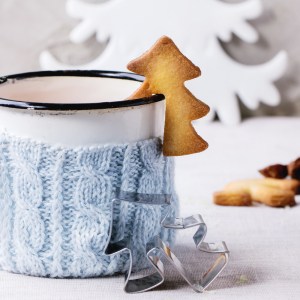
Shortbread Christmas cookies for cups

Several years ago, before I shifted from being an employee to focusing on my writing, I was a development officer, also known as a fundraiser. One of the most fulfilling parts of the job was getting to know my donors—not their capacity for giving, because I quickly learned that most people want to give, to be a blessing—but learning why giving back was important to them.

These were generous people and it was an honor to get to know them and their families. I loved hearing their stories because I realized that few of the benefactors that I met came from enormous wealth; it was just that they had an enormous inclination to share their blessings with others. And the gifts were not always monetary, some gave time, some gave lectures or internship advice, others hosted events. Part of being creative about giving is recognizing that it is not always necessary to write a check to serve others. If you can, that is great, but all of us have some unique gift we can share with the world. Continue reading

NaNoWriMo – I Finished!

Reporter working at typewriter.

 I did it! I wrote over 50,000 words for my novel during National Novel Writing Month (NaNoWriMo). In NaNoWriMo, you are declared a winner by finishing 50,000 words, but I felt like a winner after the first week. As I said in my first NaNoWriMo post at the beginning of the month, this was a challenge to find out what I could accomplish with focused effort. I know that my novel needs more work and lots of revision, but it feels great to have started.

Some of the lessons I learned are: Continue reading

NaNoWriMo – Day 18 Word Count

Reporter working at typewriter.

It is Day 18 of National Novel Writing Month (NaNoWriMo), my word count is 27,518 and I am not finished writing for the day. It is time to take a break and get some fresh air, run a few errands. I took my time writing today because I had to write a pivotal scene that I have been building towards for weeks (or should I say words?)

Something happened in my novel this week that was not planned. The story took a direction that I had not foreseen, so I followed it down the corridor to see where it was leading me. I also had a glimpse of what another novel could be, based on some of the subplots and characters I might not be able to include in this story. No need to get ahead of myself, I still have lots of work to get to 50,000 words.

Have a good weekend!

NaNoWriMo Day 11 Word Count

Reporter working at typewriter.

This is a quick NaNoWriMo update – as I anticipated, this has been a slow week for writing, due to some other work that had to come first. I am just over 16,000 words and that is fine given all that is going on. I have written something for my novel every day this week, so consistency has been good. That’s what I am learning this month, that consistency is the way to getting things done. Next week is going to be better, I don’t have so much on my schedule.

Have a good weekend!

Ramona

NaNoWriMo – Day 4 Word Count


Reporter working at typewriter.

Hello and thank you for checking in on me! I have received so many encouraging words – here, face-to-face, and through email. Last week I told you about my commitment to participate in National Novel Writing Month, also known as NaNoWriMo. I’ll need to complete 50,000 words by the end of November; this is my weekly update.

Great news – it is Day 4 and I have 12,730 words on my work-in-progress! I set a faster pace for the first week because I know that I have other projects coming up and the holiday, so I wanted to get off to a strong start. I am having a blast, and like the characters that I am writing about. Wish me well, I am going to keep it up!


NaNoWriMo 2016

Vector counter icon

NaNoWriMo, National November Writing Month, begins next week on November 1. For 30 days, I will join hundreds of thousands of writers around the world, working towards one goal—to complete a novel of 50,000 words during November. This is my first time participating in NaNoWriMo and I am excited.

I usually write shorter pieces, such as essays and profiles, and I have never completed anything this lengthy or large or imposing in my years as a writer. But I have various stories floating around in my imagination, stories that I want to explore, and I decided it would be a good challenge; I want to see what I can create after a month of focused work. I will need to write nearly 1,700 words every day to get to the finish line, but I am certain that some days will have me zipping past that goal, while other days will be a struggle to get down the first few sentences.

On December 1, I do not expect to have what could be truly called a novel, at best, it will be a messy draft, a jumble of words, twisted plots, and characters. Part of me wonders if by rushing through this process, I can develop any real sense of what it means to write a novel. I know that the real work of writing comes in revision, not in the first draft. I did not learn how to swim by putting on a swimsuit, or run by choosing running shoes based on color. After November, I may have to walk away from this work for a while, giving it time to settle in, and go back later and revise it into something that can carry the label “novel.” It doesn’t matter; I am thrilled by the prospect of trying to tell a story that is interesting enough to hold my attention for its first 30 days.

Accountability is a good partner, so I will post my word counts here every Friday during November, which will keep me focused on my progress and let you know how I am doing. If you think you have a good story in you, and want to join me, you can sign up at NaNoWriMo or just start writing on your own.

Reporter working at typewriter.Starting word count: zero, but lots of ideas…

We are All Artists

img_0365

It took a while before I felt comfortable calling myself a writer. Saying that you are a writer elicits so many questions. Some are easier to answer, such as, “What do you write?” or “Are you working on a novel?” When I respond to the first question, I explain my love for the essay form and that my favorite genre is creative nonfiction. That term sometimes requires explanation—isn’t all writing creative?— but then I add that I use the tools of the novelist while telling a true story. This seems to help them understand, and I can point them to examples, essays, books, or magazine pieces that fall under this genre.

The second question is a bit trickier, because many people immediately think of novels when you say that you are a writer. I savor novels too, with their characters and plots, evocative descriptions, and scenes. I even made an unfinished attempt at a novel many years ago, but I did not finish it. I didn’t commit the time, the plot began to flounder, and I put it aside.

Then comes the inevitable third question “So have you written a book yet, are you published?” Even though I have been published, I had to learn that being published, the frequency of it or the recognition it can bring, cannot be my sole reason for writing. If I have labored over a work, then it is often my intent to send it out, to share it with others. But first, I had to get over imagining the book cover, the catchy title, book tours and readings. I was left with only one course of action – I had to sit down and put the words on paper. All of those imaginings are great for inspiration and ideation, but until I place the words on the page, wrestle, tease or play with them until they are properly positioned, it’s all make-believe.

Writing forces me to deal with my desire for perfection. Every time I sit down at my desk to begin a new piece, I wonder how it is going to turn out, or if it will be any good. At first. But the best part of writing is that I give myself permission to just let the words come, whether they are in a rush so swift I cannot contain them, or if they come as a measly drip, drip, drip, one tentative word at a time. When I finish the day’s writing, I always am slightly amazed at myself, not because the writing is so incredible, because it is not most of the time, certainly not right away. I am amazed because I sat down with the intention to write and I did it. I kept a commitment to myself, using a gift that I let languish for years because I was busy doing other stuff. I used to want to be like those people who discovered their vocation early in life, wishing that I had started sooner on this writing life. I have made peace with that dream, because I have lived long enough to have rich and varied experiences, and enough years have passed that I have perspective and insight about what I have gone through.

I believe that everyone is an artist of some sort. Creativity has to be nurtured, but it must also be explored. This exploration takes place when we become more aware of the diversity of thought, experience, style, and culture around us. Without this awareness of different perspectives, an adult tells a child that her picture “doesn’t look quite right,” and believes it. A writer tells a story, and because it is so foreign to your worldview, you dismiss it, instead of looking for the kernel of truth or insight, or even humor, that might be present.

I am partial to the written word, but I also have explored sewing, pottery, singing, dancing, and improving my French and Spanish. I go to hear other authors read, visit museums, poke around in small shops, searching for other ways to look at and feel the world. We are all artists of some sort, and to the question, “How do I get paid for it?” my advice is not to wait to figure out how to make money at it, at least not right away. Practice, explore, get better, and then consider if this craft is something you love enough to pursue whether it feeds you or not. I think you will be enriched by the experience of exploring your creativity, whether it becomes your livelihood or not.

Inspiration – James Baldwin and the essay

FullSizeRender

An essay is not simpler, though it may seem so. An essay is essentially an argument. The writer’s point of view is always absolutely clear. The writer is trying to to make the readers see something, trying to convince them of something. In a novel or play you’re trying to show them something. The risks, in any case, are exactly the same.

– James Baldwin