Inspiration-Women

fullsizerender

I just finished Song of Solomon by Toni Morrison, and although I have read many of her other works, this was the first time that I read this book. When I was done, I felt like something in me had cracked open.

Her words are beautiful even when the lives described are not. But there was one section that insisted I read it again and again, and it captured something I know to be true. Continue reading

Winter Meditation


fullsizerender

It has been a long time since I’ve been a fan of winter. Here in northern Indiana, winter is a series of dim gray days and snowstorms, with only occasional bursts of blue skies and sunshine.

After a heavy snowfall, I wiggled into two layers of pants, a long-sleeved tee and sweater before topping it with my down jacket. I wrapped a ruffled brown scarf around my head, tied it under my chin and then topped it with a knit cap. The previous night’s snowfall covered the driveway—again—and the city’s snowplows had pushed the snow to the curb, blocking my driveway from the street, making a quick exit impossible.

Grabbing the shovel from the garage, I began the slow process of pushing snow to the side of the driveway. Push, scoop, then toss. I hoisted the shovel to throw the snow on the growing pile, which was already three feet high. Push, scoop and toss, each time making sure that I did not gather so much snow that it was too heavy to lift.

I smile when I think of my brother’s teasing, “For someone who claims to hate cold weather, it’s funny how you keep heading further north every time you move.” He’s right; every move to a warmer climate seems to be followed by a move to one that is much colder.

There have been times when winter was fun, when I could appreciate the season despite its chilly nip at my bones. I recall making angels in the snow and snowmen with my brothers. There were days when we took out the silver saucer and rode it down the hill or dragged each other around. Those are good memories. In college, before I had to drive in the snow often, the first snowfall always occurred in October. My university was not that far from Lake Michigan and when the snow travelled eastward, it picked up more and more moisture, dumping it on northern Indiana and Michigan. I did not complain; back then it was fun. With the first snow, the kids from cities down south or the west coast were the most excited. The flurries would beckon them, luring them outside. Looking through the windows at the falling snow, they tossed on their light jackets, maybe gloves and a hat, and ran outside. They tried to make snow balls, not yet understanding that they needed to wait until there was a blanket of snow, otherwise the balls would be a mix of snow, dry leaves and blades of grass. It was better if it had snowed during the night, so that by morning the landscape had shifted from green and brown to white.

That was many years ago and by the end of February, I usually have had enough of cold weather. The best parts seem to be over—the food fest that is Thanksgiving, the holiday parties, the gathering and giving of Christmas and New Year’s Eve—these events center around time with family and friends, with special food that only comes once a year. I decorate for the holidays, going a bit more rustic and golden for Thanksgiving, and then changing into reds and greens for December.

When it is this cold I feel trapped, isolated from the world. It is too cold to walk outside and sometimes the streets are too icy and slushy to make driving safe. Winter requires slowing down, and I am forced to pay attention and move without hurrying.

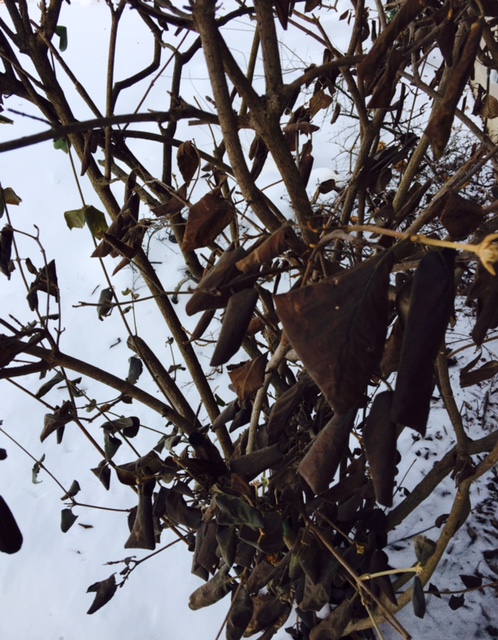
Looking outside I see my neighbors’ rooftops, the ones usually hidden by tree limbs, leaves and shrubbery during the rest of the year. I think I really should learn the names of these bushes. One is tinged red at the topmost branches, where the growth is newer from last summer. Not a dogwood, I decide. The large viburnum near the dining room window has lost nearly all of its fragrance and leaves; the ones remaining hang like brown, desiccated bats, sleeping upside down among barren branches.

I see one red roof, with a stripe of snow that has not melted. The sky is gray and cloudy, so the sun has not done its work.

I hear the chimes clanging outside. I purchased them for their pleasant sound, and when I got home I took them outside to the sunset room, the small screened-in porch that is just off of the dining room.

When it is windy in the winter I hear the chimes more often than I do when the weather is warmer; perhaps it is because there are fewer outside distractions in winter and nothing to buffer the sound. The landscape is white, sometimes so white that when it is windy that it is the only thing I see—whiteness, like a blank canvas, ready for whatever the artist chooses to place on it. The trees, except for the conifers and one resilient bush, are brown and bare. The only sounds I hear are the occasional clicks of the furnace kicking back on and the scratch of my pen against paper. Maybe that is why I hear the chimes more frequently—the world, inside and out, is still.

There go my chimes again, reminding me that there is life and movement outdoors.

I called a friend and told her I was feeling low for no apparent reason, trapped like a snow prisoner.

“What was your intention for this winter?” she asked, “ I remember talking to you about this a couple of months ago.”

Like a fierce wind, the memory rushed back.

“I said that this winter was going to be different. Instead of complaining about the cold, I’ll be grateful for the opportunity for restoration that comes with this season.”

Just as nature needs to rest and shore up energy for the promise and renewal of spring, so do I. Now I am learning how to be in flow with nature, not fighting against it.

The chiming has stopped, waiting for the next burst of wind.


Why Giving Well is Living Well


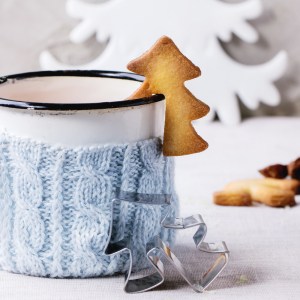
Shortbread Christmas cookies for cups

Several years ago, before I shifted from being an employee to focusing on my writing, I was a development officer, also known as a fundraiser. One of the most fulfilling parts of the job was getting to know my donors—not their capacity for giving, because I quickly learned that most people want to give, to be a blessing—but learning why giving back was important to them.

These were generous people and it was an honor to get to know them and their families. I loved hearing their stories because I realized that few of the benefactors that I met came from enormous wealth; it was just that they had an enormous inclination to share their blessings with others. And the gifts were not always monetary, some gave time, some gave lectures or internship advice, others hosted events. Part of being creative about giving is recognizing that it is not always necessary to write a check to serve others. If you can, that is great, but all of us have some unique gift we can share with the world. Continue reading

We are All Artists

img_0365

It took a while before I felt comfortable calling myself a writer. Saying that you are a writer elicits so many questions. Some are easier to answer, such as, “What do you write?” or “Are you working on a novel?” When I respond to the first question, I explain my love for the essay form and that my favorite genre is creative nonfiction. That term sometimes requires explanation—isn’t all writing creative?— but then I add that I use the tools of the novelist while telling a true story. This seems to help them understand, and I can point them to examples, essays, books, or magazine pieces that fall under this genre.

The second question is a bit trickier, because many people immediately think of novels when you say that you are a writer. I savor novels too, with their characters and plots, evocative descriptions, and scenes. I even made an unfinished attempt at a novel many years ago, but I did not finish it. I didn’t commit the time, the plot began to flounder, and I put it aside.

Then comes the inevitable third question “So have you written a book yet, are you published?” Even though I have been published, I had to learn that being published, the frequency of it or the recognition it can bring, cannot be my sole reason for writing. If I have labored over a work, then it is often my intent to send it out, to share it with others. But first, I had to get over imagining the book cover, the catchy title, book tours and readings. I was left with only one course of action – I had to sit down and put the words on paper. All of those imaginings are great for inspiration and ideation, but until I place the words on the page, wrestle, tease or play with them until they are properly positioned, it’s all make-believe.

Writing forces me to deal with my desire for perfection. Every time I sit down at my desk to begin a new piece, I wonder how it is going to turn out, or if it will be any good. At first. But the best part of writing is that I give myself permission to just let the words come, whether they are in a rush so swift I cannot contain them, or if they come as a measly drip, drip, drip, one tentative word at a time. When I finish the day’s writing, I always am slightly amazed at myself, not because the writing is so incredible, because it is not most of the time, certainly not right away. I am amazed because I sat down with the intention to write and I did it. I kept a commitment to myself, using a gift that I let languish for years because I was busy doing other stuff. I used to want to be like those people who discovered their vocation early in life, wishing that I had started sooner on this writing life. I have made peace with that dream, because I have lived long enough to have rich and varied experiences, and enough years have passed that I have perspective and insight about what I have gone through.

I believe that everyone is an artist of some sort. Creativity has to be nurtured, but it must also be explored. This exploration takes place when we become more aware of the diversity of thought, experience, style, and culture around us. Without this awareness of different perspectives, an adult tells a child that her picture “doesn’t look quite right,” and believes it. A writer tells a story, and because it is so foreign to your worldview, you dismiss it, instead of looking for the kernel of truth or insight, or even humor, that might be present.

I am partial to the written word, but I also have explored sewing, pottery, singing, dancing, and improving my French and Spanish. I go to hear other authors read, visit museums, poke around in small shops, searching for other ways to look at and feel the world. We are all artists of some sort, and to the question, “How do I get paid for it?” my advice is not to wait to figure out how to make money at it, at least not right away. Practice, explore, get better, and then consider if this craft is something you love enough to pursue whether it feeds you or not. I think you will be enriched by the experience of exploring your creativity, whether it becomes your livelihood or not.

Inspiration – James Baldwin and the essay

FullSizeRender

An essay is not simpler, though it may seem so. An essay is essentially an argument. The writer’s point of view is always absolutely clear. The writer is trying to to make the readers see something, trying to convince them of something. In a novel or play you’re trying to show them something. The risks, in any case, are exactly the same.

– James Baldwin

More or Less


more or less

Summer is almost over, the yellow school bus stops in front of my house each morning and afternoon, and one day soon I will wake up, the morning will be chilly, and I will know in my bones that it will not be getting much warmer for months. I’m okay with all of this because the summer has been pleasant—travel, family reunions and visits, long walks along the river. I began this summer with a few goals in mind and I have met most of them.

Setting some goals was helpful, and through this practice I examined how I spent my time and which things I said I wanted to do but did not finish. I felt a shift, a prompting to change direction and I am clear about the stuff I do not want to do, or at least that I won’t do for the next few months. Here are just a few: Continue reading

Yard Work is Meditation

spring grass in sun light and defocused sky

As I get older, I am becoming more like my grandfather.  I needed a break after writing and went out for a walk when my true inclination is to get ice cream. It is hot today, in the 90s, and my day started early, probably in the same manner that my grandfather would have started a sweltering summer day — early, and in the garden.

Like a farmer or gardener who has learned to become familiar with rain forecasts and the path of the sun as the day passes, I know that if I want to work in the lower part of my backyard, the section filled with daisies, hosta, violets and peony leaves, I need to be out there early, before the sun has swept over the tall trees and the neighbor’s fence. Today’s project was simple — weed the flowerbeds, yank up the vine with its slender tendrils that thicken and choke the less resilient plants. I had chopped some limbs off a bush a few days ago, but left the shorn branches in the yard, so those need to be carried off to the yard waste bin.

On days like this I recall my grandfather’s yard, his backyard in particular. The lawn, though small, was always neatly trimmed, the geraniums and petunias spilled out of pots and whirly-gigs spun around at the slightest of breezes. He had summer parties there until the year before he passed away. He was always busy in that yard, tending to a plant, painting a chair that needed a refresh, working a little bit every day. If I happened to stop by, he would offer me a drink of something cool and there were always nuts or candy in the dish on the cocktail table in the living room.

Always a fine dresser, on those days I would catch him in his work clothes, a pair of old chinos, a tee shirt, worn but never raggedy. I wonder if working in the yard was as meditative for him as yard work has become for me.

I could call what I do gardening, but I prefer the phrase yard work; it captures the honor of simple labor and tending to nature. Every time I go outside, I feel a deeper connection to the earth, and to God. When I was little I played outside but never got really dirty; childhood allergies and asthma gave me a pass from outside labor.

But now I love the work, the dirt under my nails, the recognition of what is plant and what is called weed, the sharp tools, each one designed for a purpose. I like my three pairs of gloves, red, yellow and gray, and know that on some days I will be so immersed in my work that two pairs might get soaked from working in a dewy patch or digging in the moist soil. No bother, I simply set them out to dry in the sun and grab the third pair.

I am learning to accept the bugs, bees, and butterflies that coexist to make my little patch thrive. I laugh when I remember how I jumped the first time I saw a toad sitting in a cool spot near the back fence, too sluggish to move away, but seeming to say, this is my home too.

After a morning in my backyard, as the sun rises to the point where the shade is no more and the rays are making me sweat, I decide that I have done enough for one day and it is best to stop before I get too hot, too tired, or the work becomes a chore and the element of calm dissipates. I have learned that this translates to other areas of my life, learning when I have done enough, and can stop to rest.

I take a shower, have a light breakfast and then I am ready to work some more, only this time at my desk. I can write now. And when I am done with the day’s writing, I will walk again. When I think of my yard work and walking, that is when I feel connected to my grandfather. He never owned a car, preferring to take the bus, walk, or when he was older, had his children drive him to the grocery store or run errands.

Tomorrow I will start my morning in the front flowerbed, picking out the plants that will otherwise overtake the others, watering the roses, sniffing the basil that is in a small container on my front step. I will fuss over the two pots of ornamental grass that I rescued from the twenty-five cent rack at the garden store, and look for a small sign that they are recovering from a lack of water and too much sun.

I will be grateful for this small connection to the earth, remember my grandfather and begin the day’s work.


My Favorite Love Poem


Last week I was walking along the St. Joe River; it was early morning and the day was not yet too hot. My walks are restorative and invigorating and I always come away with ideas, things about which I would like to write, or a general plan for what I want to do when I get back home.

Some mornings I prefer to walk in silence, with only the sound of the occasional passing car, a cyclist alerting me, “On the left!” or the squawking geese that make their home on the river’s banks. This morning I listened to Gretchen Rubin’s Happier podcast. Gretchen is a happiness and habits expert; you may have read her books, The Happiness Project or Better Than Before. Her podcasts, which she hosts with her sister Elizabeth Craft, share tips on how to create habits that foster happiness. They also take listener calls.

A woman called in because she wanted suggestions for a reading for her upcoming wedding and she was willing to take ideas from Gretchen or her listeners. Her request took me back to my wedding 10 years ago. I was excited because as I planned the wedding, I remembered a poem that I had always loved. I shared it with Tony before we were married, decided to use it in the ceremony, and asked my father to read it for us.

I don’t know what reading or poem the listener will use for her ceremony—I hope she finds something that she will remember for all the days of her marriage. I wanted to share the poem I selected with you. Paul Laurence Dunbar (1872-1906) wrote the poem; he was a poet, lyricist, and wrote short stories and novels. He was a black man, born in Dayton, Ohio and unfortunately, died much too young. Here is his poem, Invitation to Love.


Invitation to Love

Come when the nights are bright with stars

Or when the moon is mellow;

Come when the sun his golden bars

Drops on the hayfield yellow.

Come in the twilight soft and gray,

Come in the night or come in the day,

Come , O love, when’er you may,

And you are welcome, welcome.


You are sweet, O love, dear love

You are soft as the nesting dove.

Come to my heart and bring it rest

As the bird flies home to its welcomenest.


Come when my heart is full of grief

Or when my heart is merry;

Come with the falling of the leaf

Or with the redd’ning cherry.

Come when the year’s first blossom blows

Come when the summer gleams and glows;

Come with the winter’s drifting snows,

And you are welcome, welcome.


– Paul Laurence Dunbar


Inspiration Quote – Work and Contentment

FullSizeRender

“Contentment is work so engrossing that you do not know that you are working.”

I found this quote in poet Donald Hall‘s book, Life Work, and like it because it describes the feeling of being so absorbed in work that you can enjoy it and do not see  it as burdensome. Work often has a bad connotation because it has become too associated with employment, compensation, titles, and performance.

I prefer a simpler definition, where work is purposeful activity that has the goal of making or doing something. It can be physical, mental, creative, or spiritual. Its value is not determined by the presence or size of a paycheck. Even when I needlepoint, which is handwork, I am content and engrossed in what I am doing, and eager to see what the outcome will look like.

How do you define work and what work do you find engrossing?


Possibility

Image 6-22-16 at 10.13 AM

When I was in college, there was a girl in my dorm who loved pigs. I don’t think she was from a farming family, but she just found them to be adorable little beings. She had posters of them in her room, maybe even a few other pig-themed items. Aside from Wilbur in the book Charlotte’s Web, I thought of pigs as messy creatures, ones that lolled about in muck, ate and snorted at the same time, fleshy pink blobs with mottled brown spots. The three little pigs, with their homes made of straw, sticks and bricks were more industrious, but a wolf ended up eating two of them anyway. It was hard to fall in love with a pig.

I am from Cincinnati, home of the Flying Pig Marathon. This race winds through the city, its hills and neighborhoods, it even crosses the Ohio River into Kentucky for part of the race. It is a major attraction; over 30,000 get involved by running the marathon or one of the shorter races. The name Flying Pig sets a hopeful tone for runners, but it is also a nod to Cincinnati’s past. Cincinnati was at one time nicknamed Porkopolis, because it was the home of stockyards, slaughterhouses and the railroad system that carried meat to the cities of the Midwest. In the 1800s, the pigs were herded though the streets. The Flying Pig name evokes this history.

Any consideration of my running this race is quelled by the reality of what it would take to complete it – time spent away from goals about which I am more passionate, focused training, regardless of seasons, and the commitment to start and finish no matter the weather on race day. So I pursue other goals; a marathon is not in my future, although I did a half marathon many years ago. I have already decided I will run a race this long when pigs fly.

I dream of trips I want to take, books I will write, time spent with those I love, people that I want to meet. I visualize how I will feel when I choose the fruit over the chips, master the rollover in Pilates, or decorate the small cottage where I can go to restore my spirit. I imagine hikes I will take, strolls around botanical gardens, new cities I will explore, a girls’ trip with my daughter and granddaughter when the little one is older. And while I dream, visualize and imagine, I also plan. I write these ideas down in notebooks, jot them on my smartphone, or give them a home in my mind. At times, I share them with a friend, so we can dream out loud together, or give each other the support and accountability that a dream needs.

Sometimes I ask myself, what does the wish represent? Why is it important, are you sure that is what you really want, or is it a stand-in for something deeper? Then I sit with the thought, turning it over, volleying it back and forth as if in a tennis match, until I understand myself better or decide I can let it go.

I need to make sure that the dreaming and planning does not descend into grasping, craving, and yearning. If it seems like I am heading in that direction, I ask the why question again, and remind myself that where I am right now is a blessing, that I do not always have to be setting up the next thing.

Yet I love the idea of possibility – that there is more in this life if I open myself up, if I am less afraid, take a chance, work, ask for help and guidance, and yes, plan. Last month I was in a bookstore back home, and I came across this quirky statue of a fleshy pink pig, sitting on its haunches, snout lifted upwards, wings on its back as if it is getting ready for takeoff. The statue is ceramic, and if you look closely you can see the cracks in the glaze trailing off in a million different directions, each line leaving traces of its journey. I like that despite the apparent cracks in the piece, it is whole, entire, it has not fallen apart. Like me. A pig can fly.